

Digital Decade 2030 Report – A New Type of EU Digital Report
A new type of EU digital report: broadband internet coverage is above average, but Hungary must intensify its efforts in most areas
Although Hungary has made major progress in terms of 5G coverage and the availability of digital public services, and performs above the EU average in areas such as the coverage of gigabit home internet connections and online access to health data, it continues to face significant shortcomings in several areas that are essential to a competitive economy. These include the digital skills of society and the digital readiness of businesses, particularly small enterprises. According to the Digital Decade, the EU index measuring digital development that was published for the first time this year and replaces DESI, Hungary must intensify its efforts in all four priority areas of EU digital policy.
It has become a tradition for the European Commission to publish an annual report examining the digital state of the EU and its Member States. What is new this year, however, is that the Digital Decade has replaced DESI in summarising the results and the actions required. Two years after the European Union declared the current decade to be the Digital Decade and established its Digital Compass to address its significant shortcomings in digitalisation, the first assessment contains few positive findings for either Europe or Hungary.
The Commission considers achieving the objectives set out in the Digital Decade Policy Programme 2030 to be particularly important because doing so could generate EUR 2,800 billion in economic value, equivalent to 21% of current economic output. Overall, the first report concludes that the EU has moved towards its stated targets, but that further joint efforts are needed if Europe is to become truly competitive in digitalisation by the end of the decade.
“The Digital Decade report came as no surprise. Although it is difficult to compare its results directly with the previous DESI figures, it is clear that the same problems remain as in earlier years. Digital skills education must be accelerated—not only for school-age children, but for every age group. At the same time, small and medium-sized enterprises must be pushed towards digitalisation through regulation and incentives; otherwise, we will lose our competitiveness because of low productivity and efficiency,” – said Balázs Vinnai, President of IVSZ, assessing the 2023 European digital report.
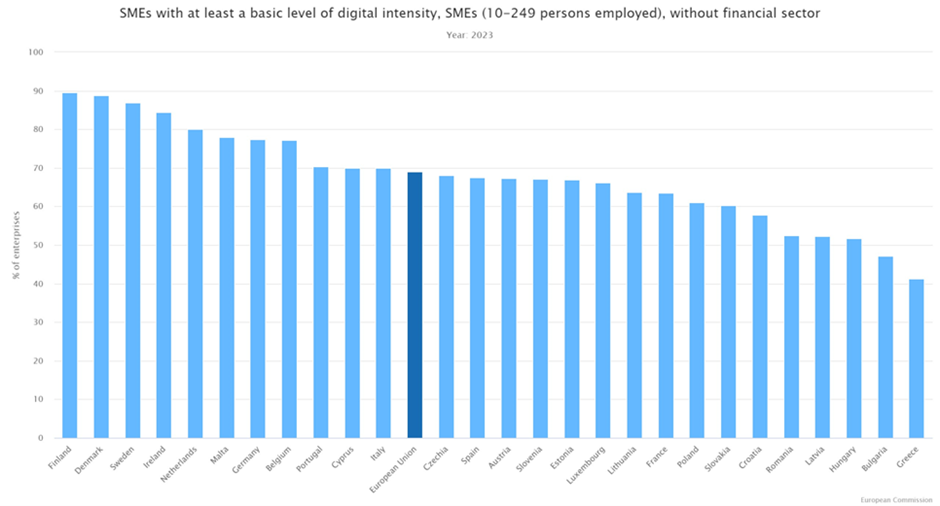
As in previous years, the Commission also published country-specific reports. In the case of Hungary, the authors of the Digital Decade report refer to untapped digital potential, although they acknowledge that Hungary has made progress in its digital transformation. The most significant improvements in 2022 were made in fixed very high-capacity network coverage and 5G coverage. However, there is still room for progress in making full use of the opportunities offered by digital infrastructure, while improving the population’s digital skills also remains a priority. Hungary also remains near the bottom of the ranking of Member States in terms of SME digitalisation.
The Brussels report notes that on 30 November 2022, the Hungarian government adopted the new National Digitalisation Strategy, which is aligned with the Digital Decade Policy Programme. It also highlights that Hungary, in cooperation with other Member States, is exploring the possibility of establishing a European Digital Infrastructure Consortium (EDIC) within the Alliance for Language Technologies to create shared infrastructure for natural language processing and large-scale multilingual models.
DIGITAL SKILLS
Hungary continues to perform below the EU average in digital skills. Only half of the adult population has at least basic digital skills, which is significantly below the EU average and leaves a long way to go to reach the 80% target set for 2030. The proportion of ICT specialists within total employment increased slightly, but the result of 4.1% still falls below the EU average of 4.6%. At 13.6%, the proportion of women among ICT specialists is one of the lowest in the EU. According to the EU’s recommendations, Hungary must do more to develop digital skills, particularly by strengthening teachers’ digital competencies and involving more adults in digital training.
DIGITAL INFRASTRUCTURE
Broadband connectivity is above the EU average, while Hungary has made significant progress in 5G towards meeting the digital connectivity targets set for 2030. In 2022, 5G coverage in Hungary increased to 58%, representing a rise of 40 percentage points compared with the previous year. Hungary’s ambitious plans include integrating a quantum computing module into a future high-performance computing (HPC) system and establishing a “national quantum laboratory.” Despite the progress achieved, the authors of the report recommend that Hungary further strengthen its digital infrastructure, particularly the deployment of 5G. It must also maintain its activity in the semiconductor and quantum fields to help the EU become a strong market player in these areas.
DIGITALISATION OF BUSINESSES
The digitalisation of businesses remains one of Hungary’s greatest challenges. Most companies, particularly SMEs, are still not making full use of the opportunities offered by digital technologies. This has a negative impact on competitiveness: in 2022, only 52% of Hungarian SMEs had at least a basic level of digital intensity, significantly below the EU average of 69%. The use of advanced digital technologies, such as big data and artificial intelligence, was less than half the EU average. According to the Commission’s recommendations, Hungary should introduce additional incentives for the digital development of businesses, particularly in skills development, to accelerate the digital transition.
DIGITALISATION OF PUBLIC SERVICES
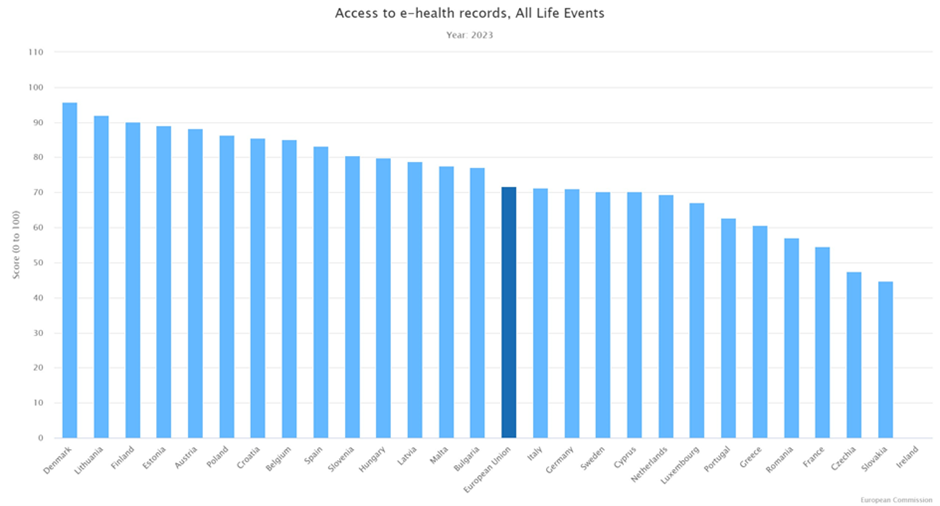
Hungary is making gradual progress in the digitalisation of public services, but still performs below the EU average in this area, with the exception of access to health data. A number of advanced digital services have yet to be introduced in Hungary’s public sector. Electronic identification (eID) and cross-border electronic identification were expected to become available through the eIDAS system in 2023. The report is unequivocal: Hungary must accelerate its efforts to digitalise public services.
Background – the European Commission’s Digital Compass for the Digital Decade 2030 is oriented around the following objectives:
- By 2030, enormous progress must be made in digital skills and digital illiteracy must be eliminated. Accordingly, by the end of the decade, 80% of the adult population must have basic digital skills, and 20 million ICT specialists—including an increasing number of female IT professionals—must be employed in the EU.
- Significant progress must also be achieved in digital infrastructure. Within this decade, every EU household must have gigabit connectivity and every populated area must be covered by 5G. In addition, European semiconductor production must be established and must account for 20% of the global market.
- The digitalisation of businesses is also a key issue for Brussels: by 2030, three out of four companies must use cloud computing services, big data and artificial intelligence. Of particular importance to Hungary and the wider region, more than 90% of SMEs must achieve at least a basic level of digital intensity.
- Public services must also be digitalised. By 2030, all key public services must be available online, with particular emphasis on healthcare services. Electronic identity cards must also achieve 100% adoption.